
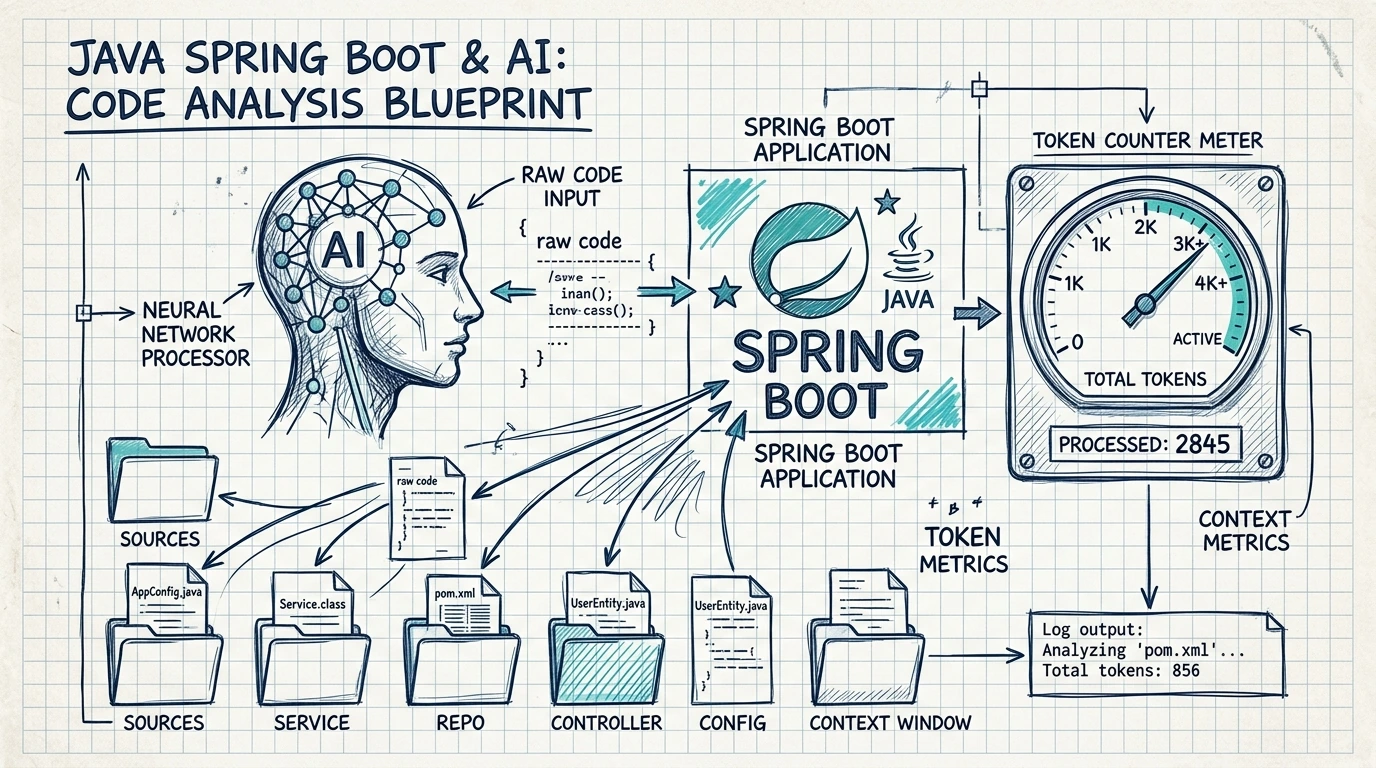
- Audience: Developers & Tech Leads
- Tech Stack: Java 21 · Spring Boot 3.x
PART 01 · CONTEXT
THE PROBLEM: Tokens are the new cost of the development lifecycle
Traditional codebases force AI to read too many files just to understand a minor change.
- Context Window: Every prompt has a limit. Scattered files = more files to load = less room for reasoning.
- Repetition Cost: AI generates errors → prompt repeated → token cost doubled. Clear architecture eliminates this loop.
- Accuracy: When context is diluted, AI guesses more. Better structure = more reliable output.
- AI Onboarding: Fresh AI every session. The codebase must self-describe so you don’t re-explain every time.
PHILOSOPHY: AI-First Code Organization
Organize source code so AI only needs to read a small, precise region to make correct modifications.
LOCALITY: Everything related to a feature stays together.
- 01 Self-describing: File, package, and class names declare their function — no external context needed.
- 02 Bounded context: Each feature has explicit boundaries; AI knows exactly what to read.
- 03 Stable contracts: Stable entry points; internal implementation changes do not leak out.
PART 02 · PRINCIPLES
06 CORE PRINCIPLES
Rules for organizing source code for AI. Apply simultaneously. Each principle reduces the tokens AI requires for a task.
- Feature-based, not Layer-based: Group by business domain, not by file type.
- One file, one responsibility: Short files, clear names — AI can digest completely.
- Explicit Public API: A single
api/folder describing everything accessible externally. - Strict Collocation: DTOs, mappers, exceptions, and tests sit alongside the logic using them.
- Colocated Documentation: Short README inside each feature serving as context anchors.
- Convention over Configuration: Predictable naming; eliminate manual wiring where possible.
PATTERN 01: Vertical Slice — Grouping by Feature
Each feature is a self-contained vertical slice: controller → service → repository → DTO → test.
FIG. 02 — Feature slice (features/billing/)
BillingControllerBillingServiceBillingRepositoryInvoice,Payment(DTO + Entity)BillingMapper·BillingExceptionBillingServiceTest
WHY DOES IT SAVE TOKENS?
- AI only needs to load a single folder to understand the full domain logic.
- No hunting for DTOs in
dto/or exceptions inexception/. - Modifying business logic in a feature doesn’t pull external files into the prompt.
- Tests sit next to code → AI generates tests closely tied to current behavior.
“Read one folder — fix one feature.”
COMPARISON: Layered (Traditional) vs Feature-based
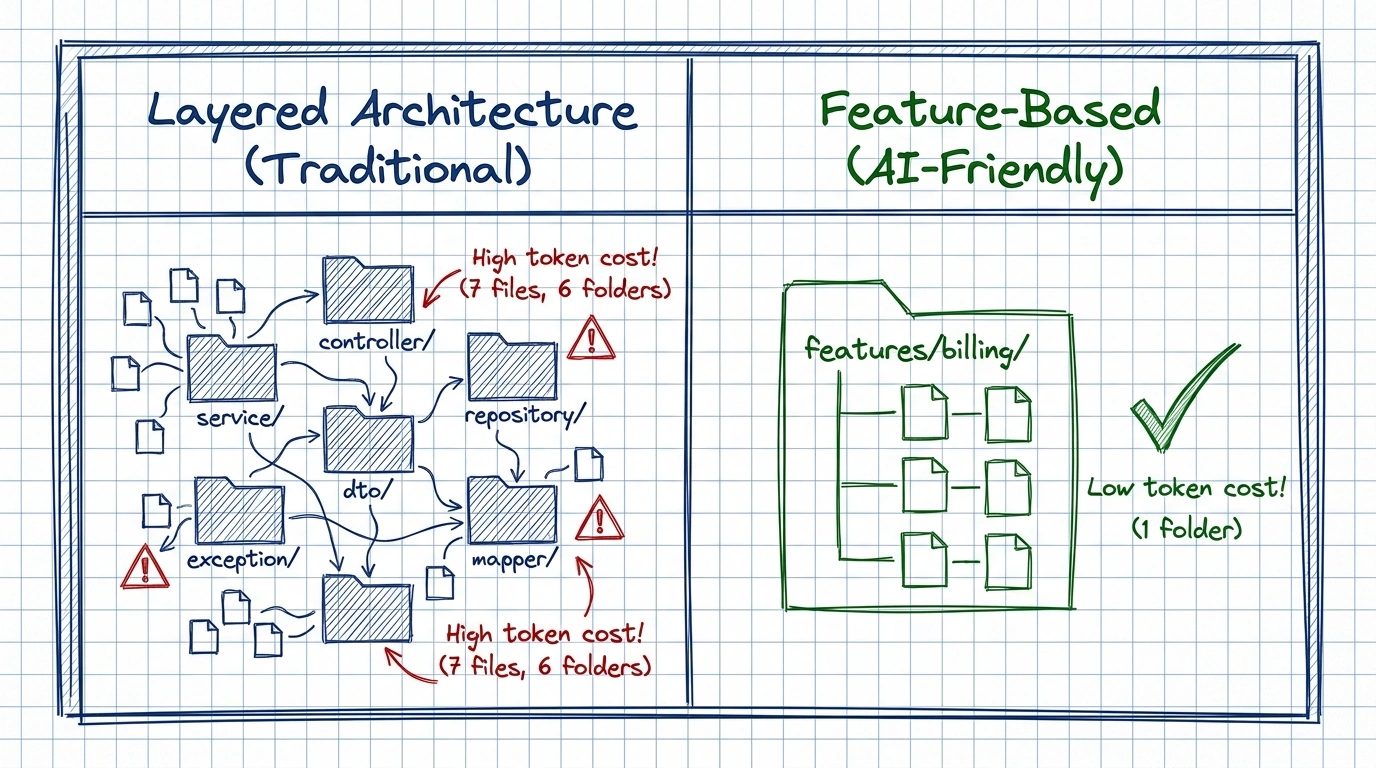
For the same business change — the number of files AI must load is vastly different.
| Layered Architecture (Traditional) | Feature-based Architecture (AI-Friendly) |
|---|---|
src/• controller/ ← 1 file here• service/ ← 1 file here• repository/ ← 1 file here• dto/ ← 2 files here• mapper/ ← 1 file here• exception/ ← 1 file here |
features/billing/• BillingController.java• BillingService.java• BillingRepository.java• dto/ Invoice.java, Payment.java• BillingMapper.java• BillingException.java |
| ⚠️ Tokens to understand 1 feature: ~ 7 files scattered across 6 folders | ✅ Tokens to understand 1 feature: 1 single folder |
PART 03 · STRUCTURE
PROPOSED DIRECTORY STRUCTURE: Spring Boot project layout
Three clean zones: app (startup), features (domain), shared (cross-cutting utilities).
FIG. 03 — src/main/java/com/company/app

app/
  Application.java           · main + @SpringBootApplication
  config/                    · 1 file per concern
features/
  billing/                   · 1 bounded context = 1 folder
    api/                     · public DTO + internal gateway
    web/                     · Controller, request/response
    domain/                  · Service, Entity, business rules
    data/                    · Repository, JPA mappings
    BillingModule.java       · public Spring config
  auth/                      · ...
shared/
  error/ result/ time/       · domain-free utilities
NAMING CONVENTIONS
- 1 feature directory = 1 domain noun.
- Mandatory suffixes:
Controller,Service,Repository. - Module class exports public beans externally.
shared/contains only domain-agnostic utilities.
💡 PROMPT TIP:
“Modify logic infeatures/billing/domain— do not touchapi/.”
NAMING CONVENTIONS: Names are the cheapest documentation for AI
Every name provides semantic hints, helping AI pinpoint the right file without reading contents.
| FILE / CLASS | PURPOSE | METHOD | PURPOSE |
|---|---|---|---|
InvoiceController |
HTTP Endpoint for invoices | createInvoice(...) |
Action + primary noun |
InvoiceService |
Use-case logic | findInvoiceById(...) |
Prefixed with find / get / list |
InvoiceRepository |
Data access | assertPaid(...) |
Checks domain invariants |
InvoiceCreateRequest |
Specific input DTO | toResponse(...) |
Clear mapper direction |
InvoiceMapper |
Entity ↔ DTO conversion | onPaymentReceived(...) |
Event handler prefixed with on |
GRANULARITY: One file — One job
Smaller files loaded into prompts are cheaper; massive files force AI to skip or skim.
- ≤ 200 lines/file: Fits local context perfectly; avoids over-fragmentation.
- ≤ 7 methods/class: Classes with > 7 methods signal a need to split responsibilities.
- 1 reason to change: Original SRP: a file changes for one business reason.
- 0 external feature dependencies: Feature logic does not call another feature directly — always via
api/.
PART 04 · DOCUMENTATION
CONTEXT ANCHORS: Living documentation beside code
Short Markdown files — AI reads once, grasps the entire module without scanning the repo.
FIG. 04 — features/billing/

README.md              · 1 paragraph purpose + list of use-cases.
ARCHITECTURE.md        · Data flow diagram, boundaries with other features.
DECISIONS.md           · Short ADR — why this approach was chosen.
api/package-info.java  · Public contract documented via Javadoc.
CHANGELOG.md           · Public API change history.
ROLE OF EACH FILE
README.mdis the anchor: 5 lines to prime AI context quickly.ARCHITECTURE.mdholds ASCII diagrams — machine-readable without images.DECISIONS.mdprevents AI from re-proposing rejected options.- Javadoc in
api/acts as a strict contract AI must honor.
BOUNDARY CONTRACT: Single gateway per module
External code only sees api/ — the rest is a black box for both developers and AI.
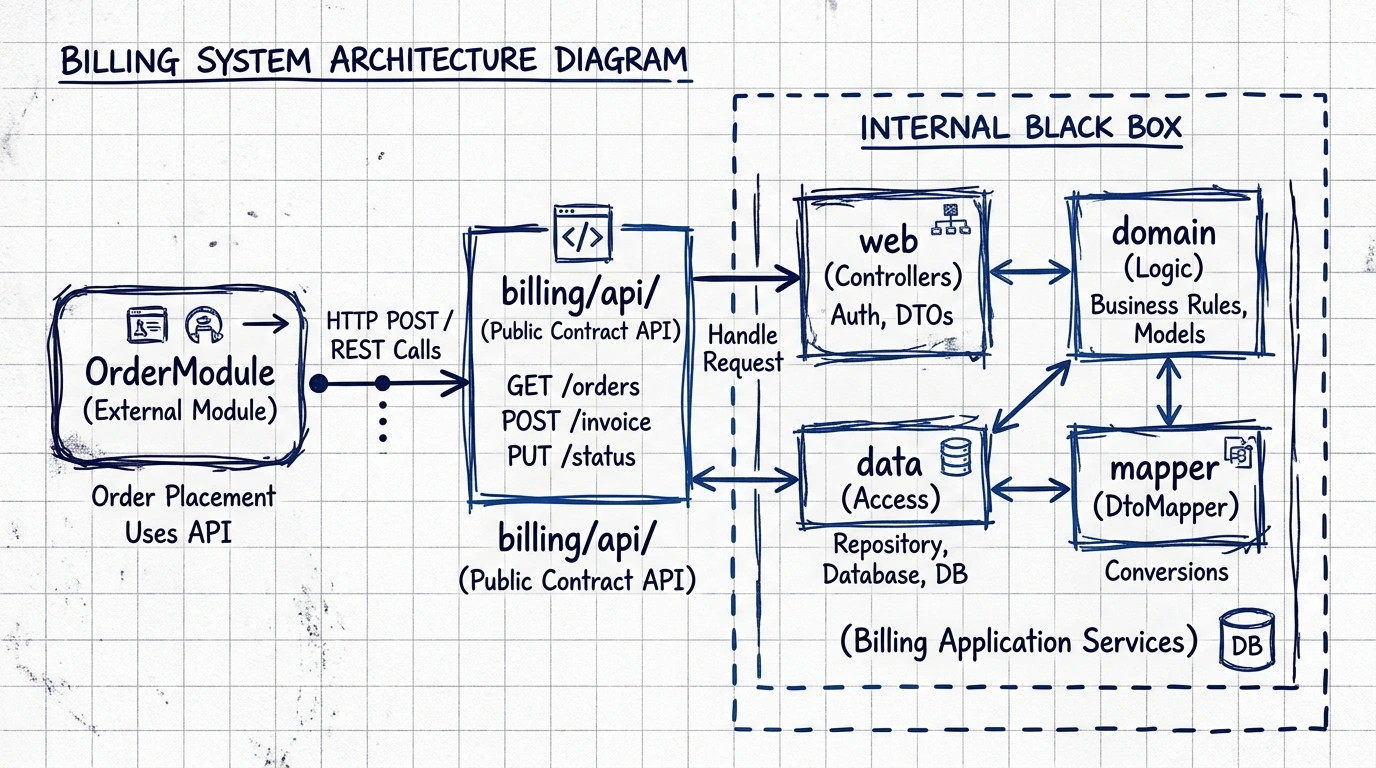
OrderModule ──> billing/api ──> [ billing (internal) ]
                                ├── domain/
                                ├── data/
                                ├── web/
                                └── mapper/
AI only reads
api/to invoke correctly — avoiding loading 20 internal files.
GATEWAY RULES
- Only immutable interfaces + DTOs reside in
api/. - Never leak JPA Entities outside the feature.
- Cross-feature calls go through Module beans, never injecting internal Services.
- ArchUnit tests strictly enforce boundaries.
PART 05 · CODE PATTERNS
PATTERNS: Token-saving structure tips
Applied at the class level — helps AI output correctly with minimal tokens.
- Self-contained DTO: Request/Response defined right next to Controller (
record). AI sees I/O right at the endpoint. - Explicit Result types: Return
Result<T,Error>orsealed class— AI understands all possible outcomes. - Static factories:
Invoice.draft(...),Invoice.finalize(...)— explicit use-case names without parsing constructors. - Minimal Annotations: Use
@RestController,@Transactionalat top level; avoid stacking 5 annotations per method. - Inline test data builder: Builders at the end of test files — AI generates new tests without searching
fixtures/. - Comment ‘WHY’, not ‘WHAT’: Code expresses WHAT. Comments only record business decisions AI cannot infer.
ANTI-PATTERNS: Practices that force AI to waste tokens
Each anti-pattern below pulls excessive files into context.
| ANTI-PATTERN | WHY IT WASTES TOKENS |
|---|---|
| God Service | Service > 1000 lines — AI constantly loads full file to modify one line. |
| Global DTOs | Shared dto/ folder with 200 cross-used records — AI can’t tell which fits. |
| Vague Common Utils | StringUtils, CommonUtils — AI guesses methods and duplicates logic. |
| Reflection / Magic | Logic relies on runtime field names — AI cannot infer behavior. |
| Scattered XML Configs | Wiring detached from classes — AI must read multiple locations for beans. |
| Circular Feature Dependencies | Requires recursive module loading — context explodes. |
PART 06 · OPERATIONS
WORKFLOW: Prompting process on the new structure
Leverage feature folders to save tokens at every step.
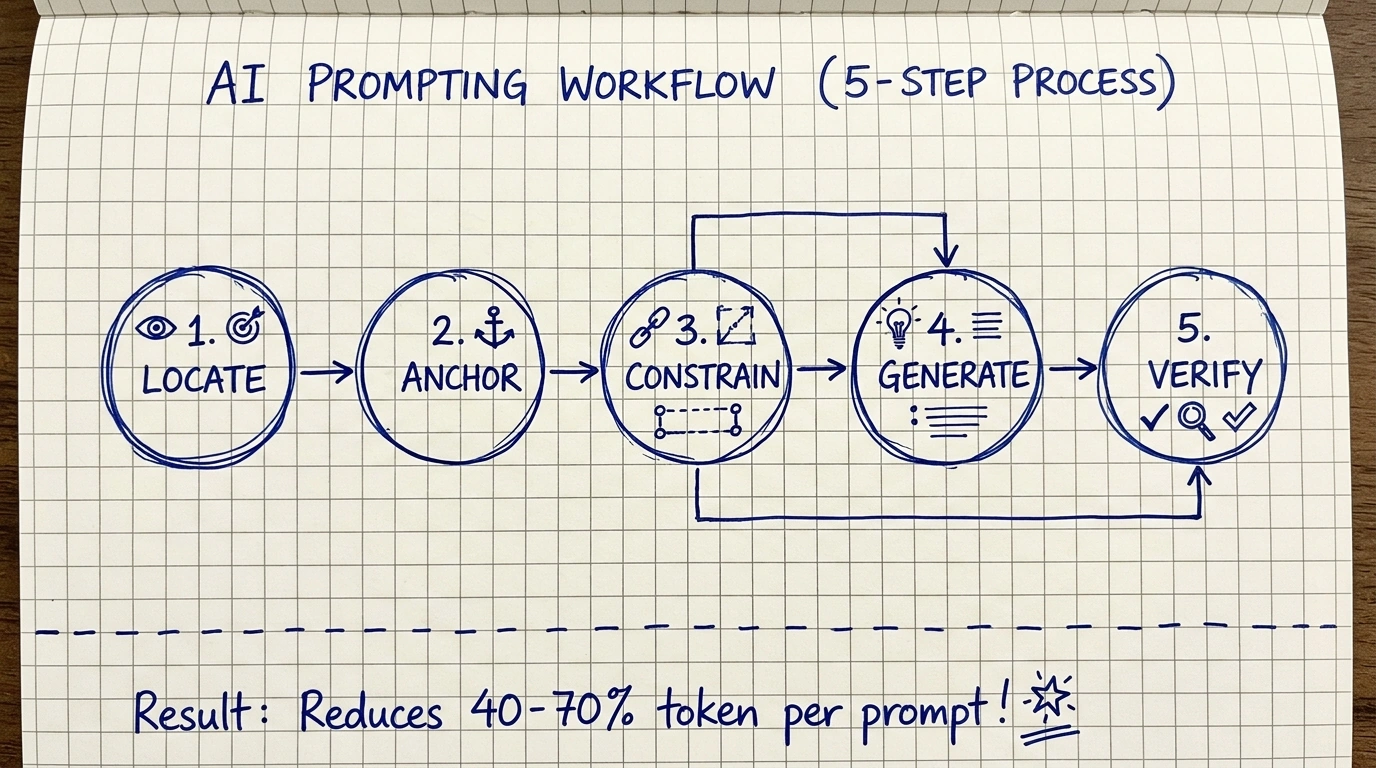
- Locate: Target only the specific feature folder — don’t paste the whole repo.
- Anchor: Attach
README.md+ARCHITECTURE.mdof that feature. - Constrain: List permitted
api/andshared/usage. Forbid other areas. - Generate: Request outputs using absolute file paths within the feature.
- Verify: Run ArchUnit + tests beside code. AI fixes loops inside the same folder.
🚀 TYPICAL RESULTS: Reduces 40–70% tokens per prompt once structured.
CHECKLIST & CONCLUSION: Audit and Apply
Ten actionable steps to transition your Spring Boot codebase into an AI-friendly state:
- 1. Refactor current project into feature folders.
- 2. Add
api/for each feature, hiding internals. - 3. Write concise
README.md≤ 10 lines per feature. - 4. Set up ArchUnit to enforce architectural boundaries.
- 5. Standardize suffixes:
Controller/Service/Repository. - 6. Colocate DTOs per feature, delete global
dto/. - 7. Replace global utils with feature-local helpers.
- 8. Add
ARCHITECTURE.mdwith ASCII diagrams. - 9. Update prompt templates to point directly to feature paths.
- 10. Track average tokens per PR — target continuous reduction.
“Good architecture is the best prompt.”
Comments (0)