
Natural Language Understanding is often introduced as the part of a conversational system that “understands what the user means.” That definition is attractive, but it sets an impossible expectation. Production software does not need to understand every nuance of language. It needs to convert a messy utterance into a small, explicit contract that the rest of the system can validate.
A useful NLU layer answers three questions: what is the user trying to do, which values are needed, and what remains ambiguous? It should then hand a structured result to policy and application code instead of directly deciding what side effect to perform.
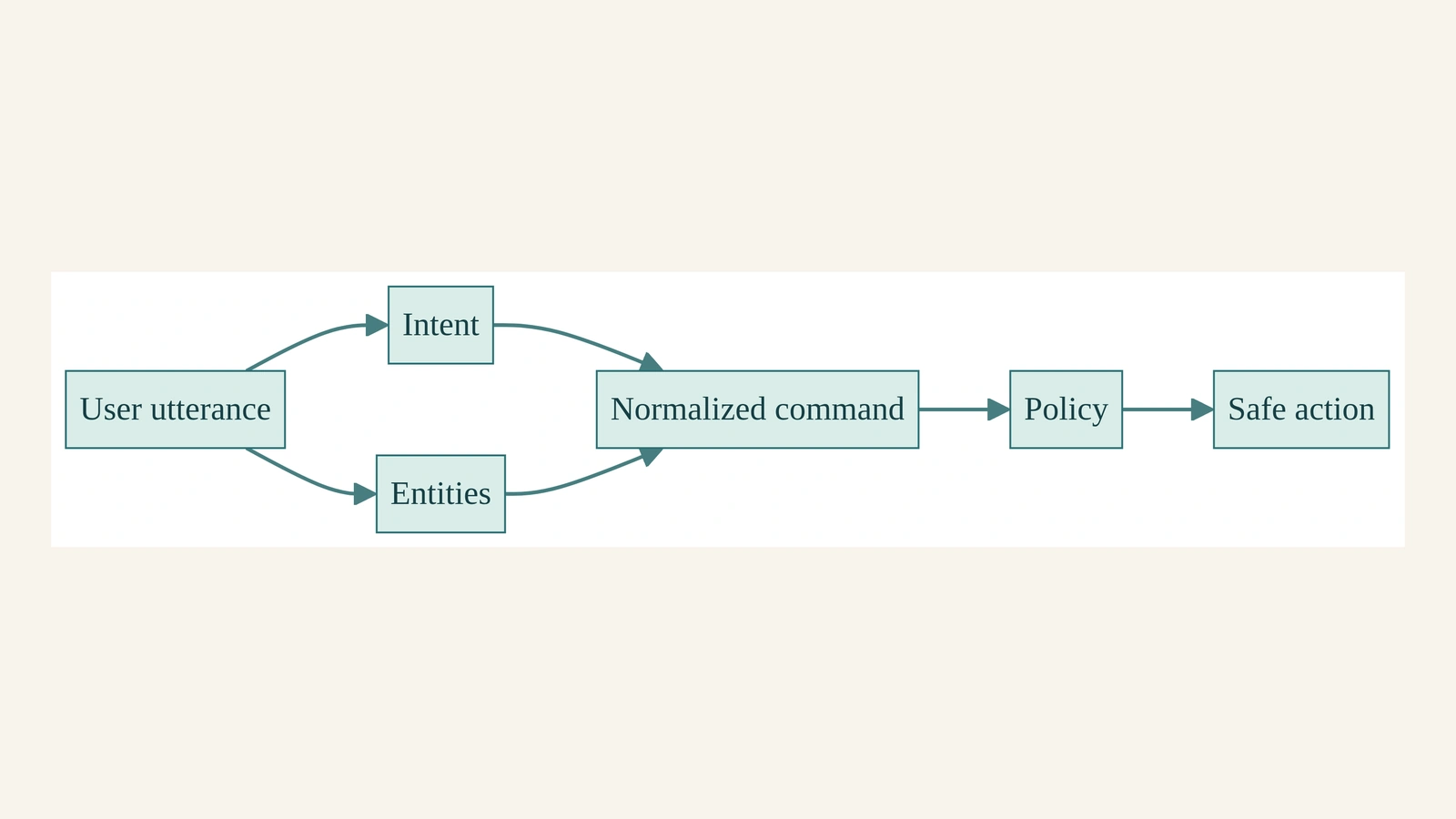
The production model is simple:
utterance -> intent -> entities -> normalized command -> policy -> actionThe model may help with the first four steps. The final policy and action decision should remain explicit, observable, and testable.
NLU is a translation layer, not a magic mind reader
Consider the message: “Can you move my meeting with Lan to next Friday afternoon?”
A useful result might be:
{
  "intent": "reschedule_meeting",
  "entities": {
    "participant": "Lan",
    "date": "2026-08-21",
    "time_window": "afternoon"
  },
  "missing": ["meeting_id"],
  "confidence": 0.91,
  "needs_clarification": true
}
This is more valuable than a fluent paraphrase. It tells downstream code what the user wants, what values were extracted, what is missing, and whether the system can safely continue.
The result should also carry context such as tenant, authenticated user, channel, locale, conversation state, and the previous action. “Move my meeting” means something different in a personal calendar than in a shared team calendar. The language model can infer candidates, but application state determines what the candidates refer to.
Design the taxonomy around user goals
An intent taxonomy is a product contract. If intent names describe internal implementation rather than user goals, the system becomes difficult to train, evaluate, and evolve.
Prefer names such as reschedule_meeting, refund_order, check_delivery_status, or reset_password. Avoid names that only make sense inside one service, such as calendar_v3_handler or route_to_workflow_7.
The taxonomy should be narrow enough that each intent has a different next step. If two intents always lead to the same policy and action, they may not need to be separate. If one intent contains several effects with different risk, split it before the ambiguity reaches execution.
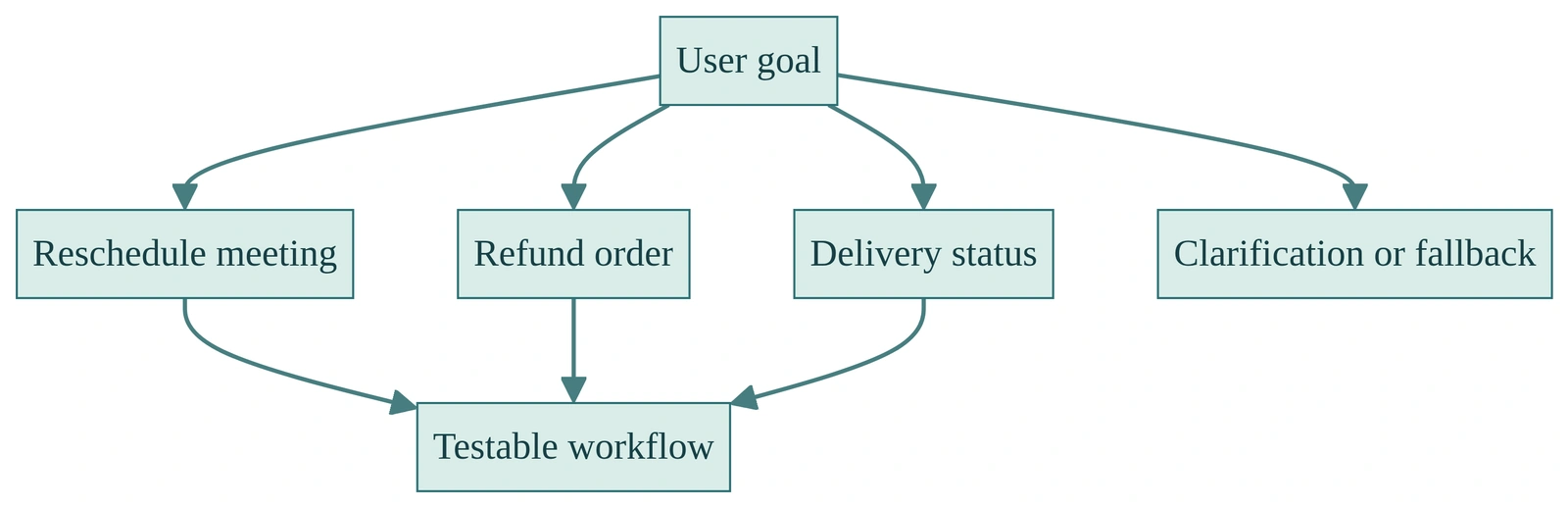
A practical taxonomy review asks:
| Question | Why it matters |
|---|---|
| What does the user want to achieve? | Keeps labels aligned with outcomes |
| What action or answer follows? | Prevents labels with no operational meaning |
| What examples belong to this intent? | Defines the training boundary |
| What similar intent causes confusion? | Creates targeted negative examples |
| What is the safe fallback? | Makes uncertainty a designed outcome |
Do not try to create an intent for every sentence pattern. Variations in wording belong in examples, synonyms, and normalization. Intents should represent meaningful goals.
Entities are only useful when a workflow needs them
An entity is a structured value extracted from an utterance: a person, order ID, date, amount, product, location, or account. It is tempting to extract everything the user says. That usually creates noise and makes the contract harder to maintain.
Extract an entity when downstream logic needs it. If the user mentions a color that has no effect on the workflow, it may not belong in the contract. If the system needs a canonical order identifier, extract and validate it even when users provide it in several formats.
Normalization is part of the NLU boundary. “Tomorrow afternoon,” “next Friday,” and “Friday after lunch” should become a consistent representation with timezone and locale rules. “Lan,” “chị Lan,” and a contact alias may need to resolve to one internal identifier, but the resolver should be explicit and permission-aware.
{
  "raw": "next Friday afternoon",
  "normalized": {
    "date": "2026-08-21",
    "start_time": "13:00",
    "end_time": "17:00",
    "timezone": "Asia/Ho_Chi_Minh"
  },
  "assumptions": ["locale=vi-VN", "reference_time=2026-08-14T09:00:00+07:00"]
}
The system should be able to show or log important assumptions without storing unnecessary raw text.
Confidence is a routing signal, not permission
A confidence score can help choose the next step. It should not grant permission to perform an action.
High confidence with a missing required entity should lead to a clarification question. Low confidence for a harmless read may be acceptable with a broad answer. High confidence for a payment or deletion still requires policy and possibly human approval.
Use thresholds by intent and effect rather than one global cutoff:
| Situation | Safe response |
|---|---|
| High confidence, complete low-risk request | Continue under policy |
| High confidence, missing required value | Ask a focused clarification |
| Medium confidence, reversible action | Show interpretation and ask confirmation |
| Low confidence, high-impact action | Do not act; request clarification or human review |
| Conflicting entities or context | Surface the conflict instead of guessing |
The system should also make “I do not know” a valid output. A fallback is not a model failure; it is a controlled state that prevents an uncertain interpretation from becoming an unsafe action.
Clarification should reduce uncertainty efficiently
A bad clarification question asks the user to repeat everything. A good one asks for the smallest missing piece.
If the user says “cancel my order,” and there are three open orders, ask which order. If the date is ambiguous, present the interpreted date and ask for correction. If the requested action is not allowed, explain the boundary and offer a safe alternative rather than asking the same question again.
The clarification state should be explicit in the conversation state. Otherwise, the next user message may be classified as a new unrelated intent and the system will lose the question it was trying to answer.
Keep NLU separate from authorization
NLU can identify transfer_money and extract an amount and recipient. It must not decide whether the user may transfer that amount to that recipient.
Authorization needs authenticated identity, account state, limits, tenant boundaries, transaction history, and current policy. These facts are not reliably represented in a user utterance. The same NLU output can be allowed for one user and blocked for another.
The handoff should be a typed command candidate:
{
  "intent": "transfer_money",
  "entities": {
    "amount": 500,
    "currency": "USD",
    "recipient": "account_98"
  },
  "context": {
    "actor": "user_17",
    "tenant": "shop-17"
  },
  "status": "candidate"
}
Policy code then verifies limits, ownership, risk, freshness, and approval requirements. This boundary is especially important when NLU becomes part of a tool-using agent. Understanding a request is not authorization to execute it.
Evaluate by slices, not one accuracy number
A single intent accuracy number hides the failures that matter. Measure by intent, language, channel, entity type, user segment, noise level, and risk tier.
Track at least four kinds of errors:
- intent confusion, where the system chooses the wrong workflow;
- entity extraction error, where a value is missing or incorrect;
- normalization error, where the value is parsed but interpreted incorrectly;
- abstention error, where the system acts when it should have asked.
The fourth category is often under-measured. A system that refuses too often is frustrating, but a system that guesses incorrectly on a high-impact action is worse. Evaluation should weight errors by consequence, not only by count.
Build fixtures from real conversations after removing sensitive content. Include spelling errors, code-switching, incomplete requests, ambiguous references, conflicting values, old product names, and adversarial attempts to change the system’s policy. Connect them to the same agent regression suite used for downstream tool behavior.
Observe the contract without logging everything
Production NLU needs enough telemetry to answer why a request was routed or rejected. Log the normalized intent, entity presence, confidence bucket, fallback reason, policy outcome, model version, taxonomy version, and latency. Protect raw utterances and sensitive entities with the same discipline used for privacy-aware agent observability.
A useful trace follows the full handoff:
utterance_received
  -> nlu_classified
  -> entities_normalized
  -> clarification_or_command
  -> policy_decision
  -> action_executed
This makes it possible to distinguish a language problem from a policy problem. If the intent and entities were correct but the action was blocked, the NLU model should not be “fixed” to bypass authorization.
A small contract is easier to evolve
Taxonomies change as products change. New actions appear, old actions retire, and users invent new ways to ask for the same thing. Keep the contract versioned and make changes visible.
When an intent is split, support both versions during migration if historical conversations or analytics depend on the old label. When an entity changes meaning, use a new field name rather than quietly changing the old one. When a fallback reason changes, preserve enough information to compare behavior before and after the release.
The goal is not to build a perfect language model. The goal is to create a stable boundary between language and software behavior.
NLU in production is successful when it turns a messy utterance into a typed, inspectable, and appropriately uncertain command candidate. The system then asks for what is missing, refuses when the risk is too high, and passes only validated actions to policy and application code. That is a much smaller promise than “understand everything,” but it is one a production system can actually keep.
Comments (0)