
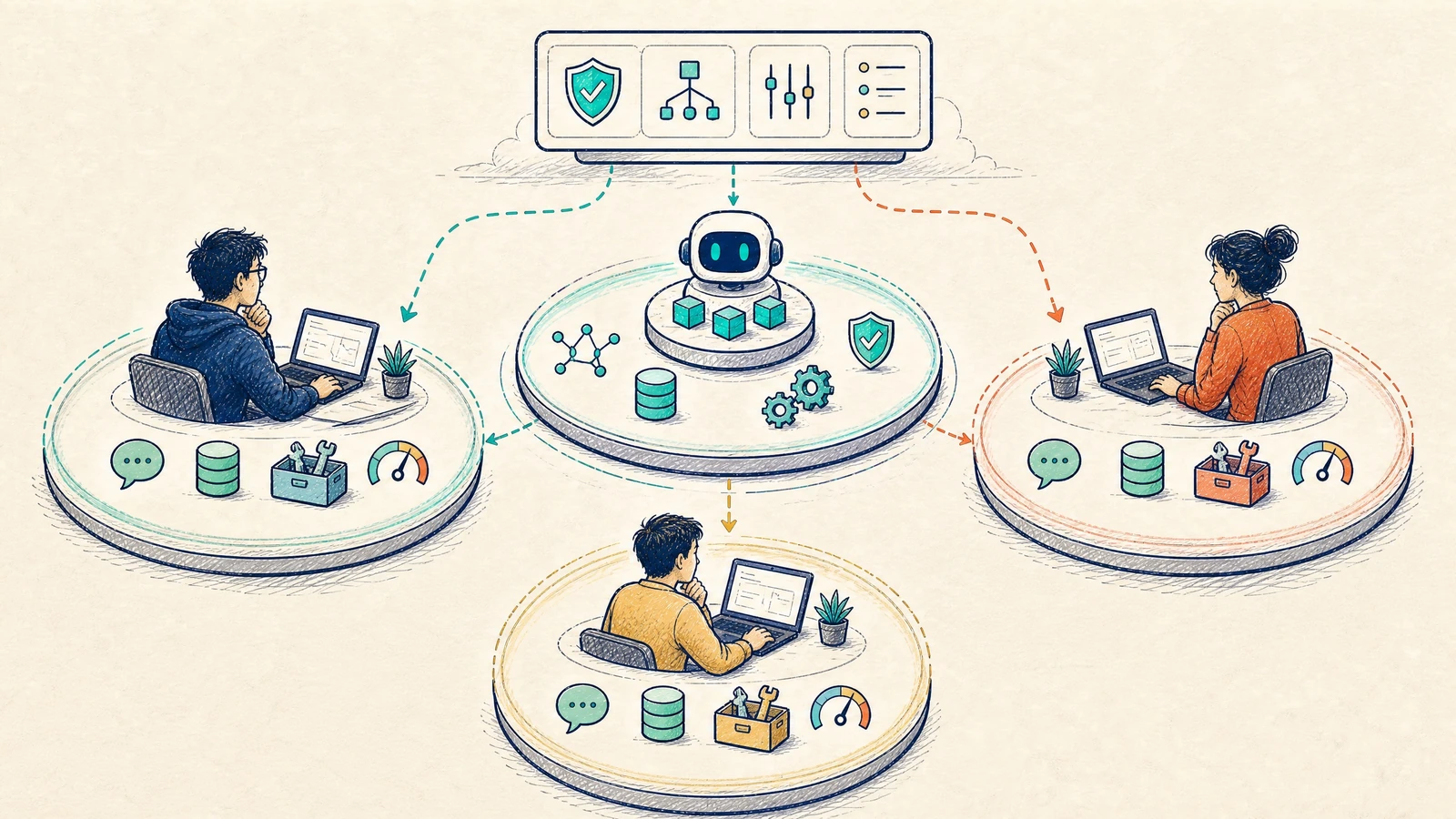
The first version of an AI agent platform usually has one customer, one workspace, one vector index, one set of tools, and one bill. The architecture feels clean because the boundaries are mostly implied by the application process.
Then the second customer arrives.
The platform now has to answer questions that a single-tenant prototype was allowed to ignore. Can a prompt from tenant A influence a tool choice for tenant B? Can a memory search return a result from the wrong workspace? Which tenant pays when a shared model call expands its context three times? What happens when one customer submits a burst that consumes the queue for everyone else?
These are not only authorization questions. They are systems-boundary questions. A platform may correctly authenticate a request and still leak data through a cache key, a trace attribute, a shared prompt template, a vector filter, a retry queue, or a cost dashboard.
This article describes multi-tenancy as an end-to-end property of an AI agent platform. It focuses on prompt, tool, memory, model routing, observability, rate limits, secrets, and billing attribution. The aim is not to prescribe one isolation tier for every customer. It is to make the boundary explicit so that a team can choose where to share and where to separate.
The thesis: Tenant isolation is not a column added to the request table. It is an invariant that must survive every hop from ingress to model context, tool execution, memory retrieval, trace storage, retry, and invoice.
The tenant boundary moves through the whole request
A useful request envelope should carry tenant identity and policy context from the edge to every component that can read, write, execute, or observe data.
{
  "request_id": "req_01J...",
  "tenant_id": "tenant-17",
  "workspace_id": "workspace-3",
  "actor_id": "user-42",
  "data_class": "restricted",
  "region": "approved-eu",
  "policy_version": "tenant-policy-8",
  "budget": {"tokens": 24000, "usd": 0.12}
}
The envelope is not a security boundary by itself. It is a carrier for decisions that must be enforced downstream. Every service should either receive a verified envelope or reject the request. Reconstructing tenant_id from an untrusted header in the middle of the request is not propagation; it is a confused-deputy risk.
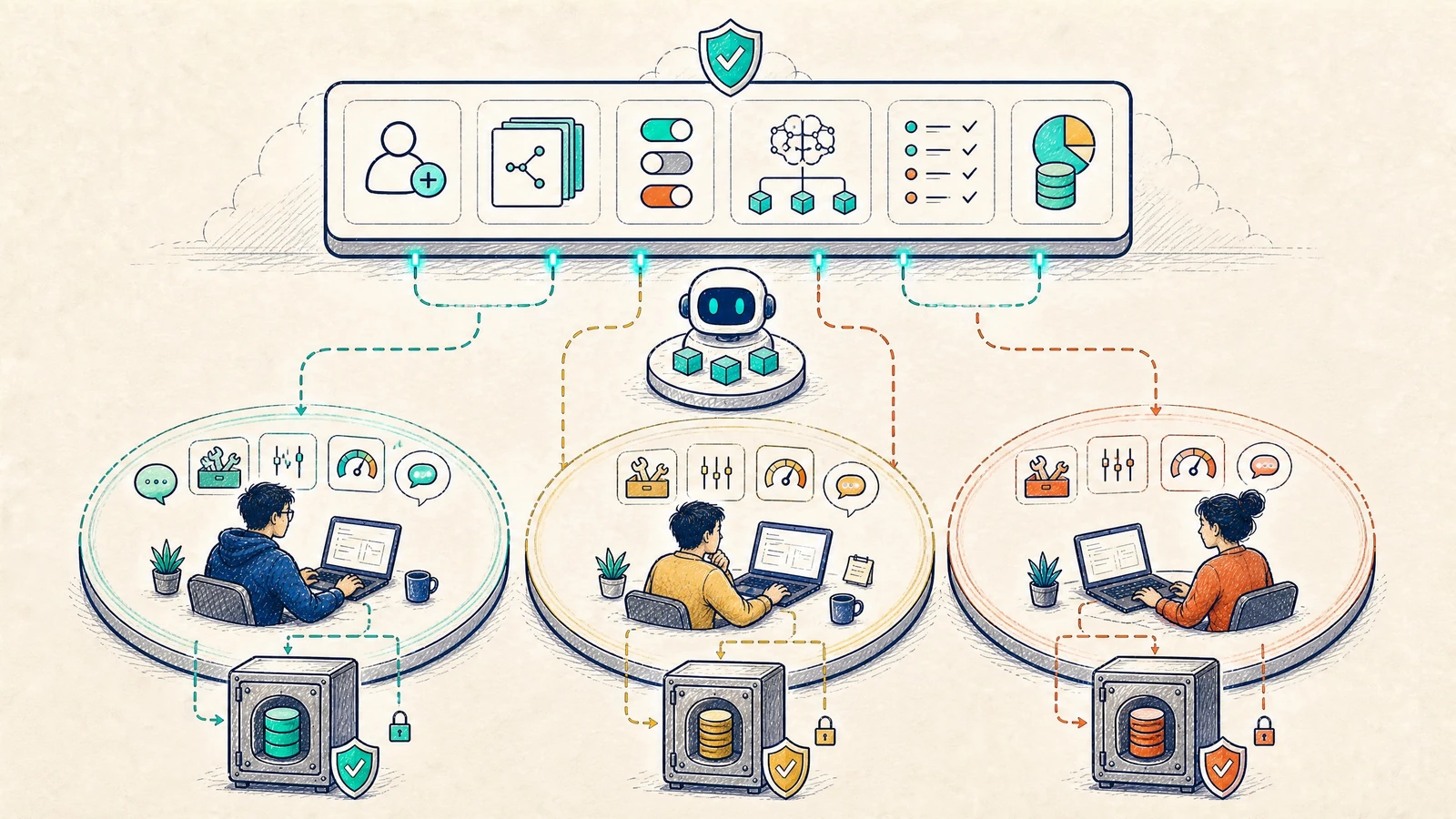
A platform usually has two broad planes:
| Plane | Responsibilities | Isolation expectation |
|---|---|---|
| Control plane | Tenant lifecycle, plans, policy versions, model catalog, feature flags, billing rules | Shared metadata may be acceptable, but every record is tenant-scoped or explicitly global. |
| Data and execution plane | Prompts, memory, tools, secrets, model requests, traces, artifacts | Default deny across tenants; sharing must be explicit and testable. |
The control plane can be shared without making the execution plane shared. Conversely, a separate database does not help if a common prompt compiler or trace exporter merges tenant data before storage.
Four isolation tiers are better than one slogan
“Multi-tenant” describes a product shape, not a single architecture. Different tenants may justify different isolation tiers.
| Tier | Typical shape | Strength | Cost and operational trade-off |
|---|---|---|---|
| Shared tables | Shared database with mandatory tenant keys and row-level policy | Efficient for many small tenants | A missing filter can become a cross-tenant incident. |
| Shared database, separate schema or index | Logical storage separated by schema, collection, or index | Clearer data boundaries | More migrations and catalog management. |
| Dedicated execution namespace | Separate queues, secrets, workers, or Kubernetes namespace | Stronger noisy-neighbor and runtime control | More capacity planning and deployment overhead. |
| Dedicated environment | Separate account, cluster, or region | Strongest blast-radius reduction | Expensive; requires mature automation. |
The correct tier depends on data sensitivity, contractual requirements, workload shape, and the failure the platform is trying to contain. Do not advertise a shared vector index as “isolated” merely because every query includes a filter. That filter is necessary, but its correctness must be tested, monitored, and protected from bypass paths.
A practical design starts with a tenant isolation matrix: for each resource, record the key, owner, read path, write path, cache behavior, retention, and audit event. If a resource has no clear owner, it will eventually become shared by accident.
Prompt isolation includes templates and history
The obvious risk is a prompt injection from one tenant. The less obvious risk is accidental reuse of tenant-specific context.
Prompt assembly may combine system instructions, product policy, tenant configuration, user message, memory, retrieved documents, tool descriptions, and previous turns. Every source needs a provenance label and an authority level. A tenant’s custom instruction should not be allowed to override a platform safety rule merely because it appears later in the string.
Use namespaced prompt templates and version them:
system/platform/v4
policy/tenant-17/v8
agent/support/v3
memory/tenant-17/user-42
retrieval/tenant-17/case-4821
user/request-01J...
The names are illustrative, but the principle is important: a prompt compiler should be able to answer where every block came from, which tenant owns it, and whether the block is allowed in the current model request. This is related to context engineering, but the tenant question comes first: context relevance is not permission.
Do not use a global semantic cache unless the cache key includes all policy-relevant dimensions. A semantically similar question from two tenants must not share an answer if their data, tools, policy, or contract differs. In many systems, an exact cache with a complete tenant and policy key is safer than a clever semantic cache with a partial key.
Tool isolation is authority isolation
A tenant should not merely receive a filtered list of tools. The platform should bind tool authority to the tenant, actor, workflow, data class, and current step.
For example, two customers may both have a search_cases tool, but the underlying data scope and maximum page size differ. One tenant may have a read-only CRM integration; another may have an approved write capability. The tool name alone cannot carry the full security meaning.
A tool invocation envelope can make the missing dimensions visible:
{
  "tenant_id": "tenant-17",
  "actor_id": "user-42",
  "workflow_id": "wf-88",
  "capability": "case.search",
  "scope": {"workspace_id": "workspace-3"},
  "side_effect": "none",
  "deadline_ms": 1800,
  "idempotency_key": null
}
The tool service must verify the envelope independently. Never trust the model to respect tenant boundaries, and never rely on a prompt sentence such as “only access this workspace.” The model can choose a tool; the service decides whether the call is authorized.
This is different from the MCP least-privilege problem covered in the MCP security article. That article focuses on capability and protocol boundaries. Multi-tenancy adds a second question: even when a capability is allowed, which tenant’s data and credentials may it touch?
Secrets need the same treatment. Resolve them at execution time through a tenant-aware secret broker, do not inject every customer secret into a shared worker environment, and never place secrets in model context or general-purpose traces. A tool should receive the minimum credential needed for the specific operation.
Memory and retrieval are the common leak paths
Memory systems are attractive because they make agents feel consistent. They are also a frequent place where tenant isolation becomes implicit.
Separate at least these scopes:
| Memory scope | Example | Isolation rule |
|---|---|---|
| Platform | Global safety policy or public product documentation | Explicitly global, versioned, and reviewed. |
| Tenant | Customer configuration and organization facts | Shared only within the tenant boundary. |
| Workspace | Project-specific knowledge | Never returned outside the workspace. |
| User | Personal preferences and private history | Never promoted to tenant memory without consent. |
| Task | Temporary facts for one workflow | Expire with the workflow or retention policy. |
A vector filter should be generated from a verified authorization context, not from a model-generated string. The retrieval service should reject a query without a tenant scope and should record the scope used for every result. The same principle applies to reranking, summaries, embedding jobs, deletion, and reindexing.
The platform also needs deletion semantics. If a tenant removes a document, does the source disappear but the embedding remain? Does a summary still contain a fragment? Does a cached answer remain visible? Data lifecycle is part of isolation because stale copies can cross a contractual boundary even when the primary database is correct.
Noisy neighbors are a correctness problem
A tenant that submits a large batch can affect everyone through shared model concurrency, queue depth, vector search, GPU memory, or database connections. This is usually called the noisy-neighbor problem, but “performance issue” is too weak. Under pressure, teams disable limits, increase timeouts, or take fallback paths that can weaken data and policy controls.
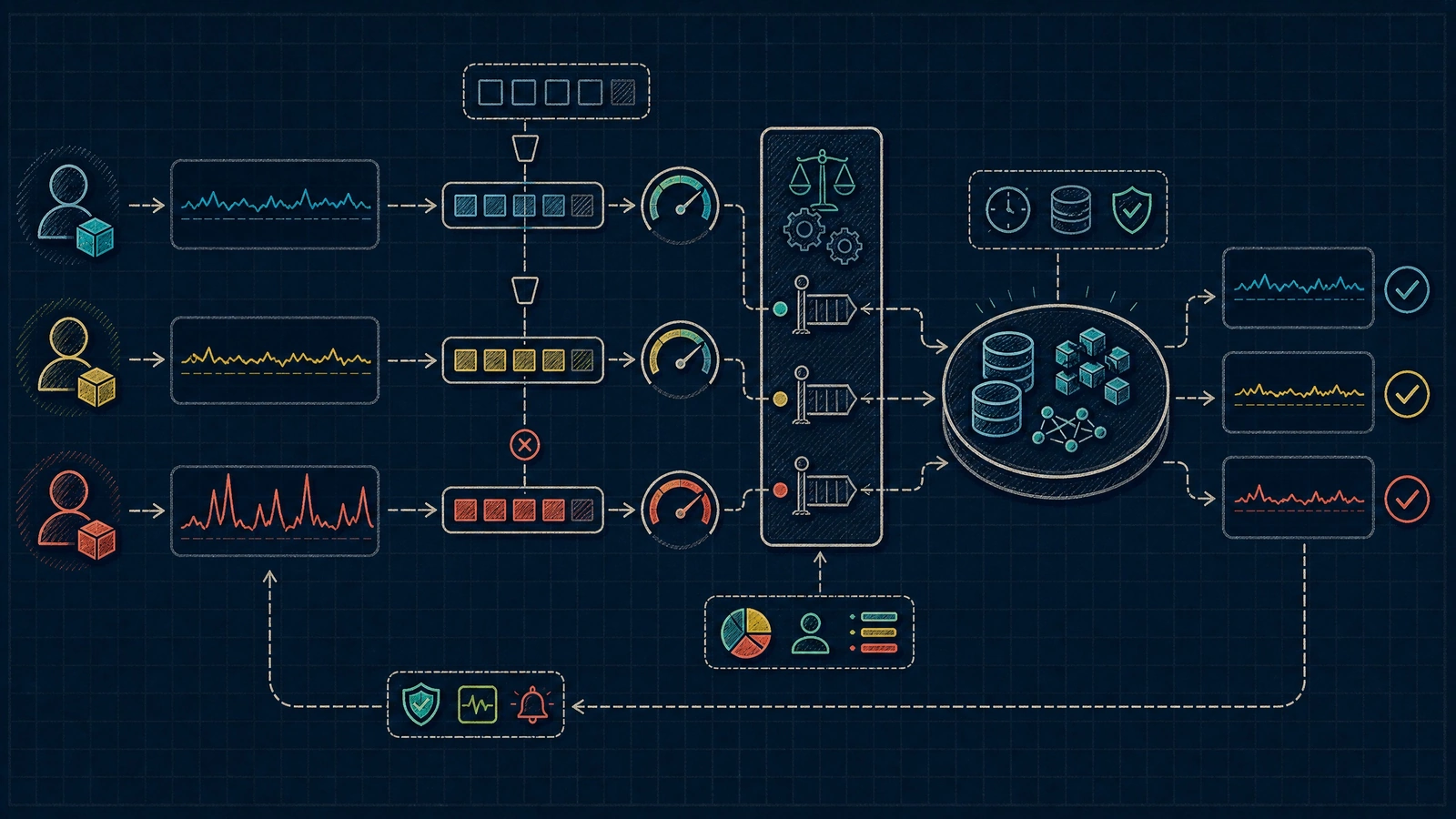
Use several controls together:
| Control | What it protects | Important detail |
|---|---|---|
| Admission limit | Overall system capacity | Reject or defer before work enters expensive stages. |
| Per-tenant concurrency | Fairness | Count active model and tool work separately. |
| Token budget | Cost and model capacity | Account for input, output, retries, and context expansion. |
| Priority queue | User-facing latency | Define who can preempt batch work and why. |
| Load shedding | Platform survival | Return a visible retry or queue state, not a silent timeout. |
| Fair billing | Customer accountability | Attribute shared overhead using a declared rule. |
Limits must apply to retries and background jobs, not only the first request. Otherwise a tenant can appear within its request rate while its failed tasks keep consuming the platform in the background.
A cost dashboard should show both direct and allocated cost. Direct cost includes model tokens, storage, and tool usage. Allocated cost may include shared workers, retrieval infrastructure, cache misses, and failed attempts. The allocation formula need not be perfect, but it should be stable and explainable. “The platform paid more this month” is not a tenant policy.
Observability must preserve the boundary
A trace can leak as easily as a database query. A shared trace system needs tenant-aware access control, field-level redaction, retention policy, and safe correlation identifiers.
At minimum, include tenant identity in the authorization context for trace reads, but avoid treating the tenant label as a free-text attribute. Normalize it, validate it, and ensure that dashboards cannot be queried across tenants unless the operator has a platform-level role.
Record useful metadata without copying secrets or raw user content by default:
tenant_id: tenant-17
workflow_id: wf-88
route_id: rt-01J...
tool: case.search
input_tokens: 1840
policy_version: tenant-policy-8
result: allowed
redaction: applied
Trace joins are another trap. A request ID from one tenant should never be reused as a public correlation ID for another tenant. Background jobs should carry a new internal job ID while preserving the authorized parent relationship.
The platform’s incident response process should include a tenant-impact query: which tenants were in the affected queue, cache, worker, index, or provider route? Without that dimension, a team cannot determine blast radius quickly.
Test isolation like a distributed invariant
Do not rely on a few happy-path unit tests that assert tenant_id appears in one SQL query. Test the ways data crosses boundaries:
- remove the tenant filter from one repository call and verify a policy test fails;
- send a prompt containing a token from tenant A through a worker assigned to tenant B;
- create semantically identical requests in two tenants and inspect cache behavior;
- replay a retry after a worker lease expires;
- delete a document and query every memory, summary, embedding, and cache path;
- run a batch tenant until queue and token limits engage;
- inspect traces with a tenant-scoped operator account;
- rotate a tenant secret while a queued tool call is waiting.
A production test should assert both positive and negative properties: tenant A can read its own approved data, and tenant A cannot read tenant B’s data even when the tool arguments, vector query, cache key, retry path, or trace filter is malformed.
A rollout sequence that keeps the platform honest
| Phase | Work | Evidence |
|---|---|---|
| Inventory | List every tenant-bearing resource and path. | Isolation matrix reviewed by engineering and security. |
| Envelope | Add verified tenant and policy context to all calls. | Contract tests reject missing or inconsistent context. |
| Storage | Enforce tenant scopes at database, vector, cache, and object layers. | Negative cross-tenant tests pass. |
| Execution | Add tool authorization, secret brokerage, queue limits, and leases. | Load and failure tests preserve isolation and fairness. |
| Observability | Apply tenant-aware trace access and redaction. | Operators can investigate without overexposure. |
| Canary | Migrate a small tenant cohort. | No unexplained data, cost, or latency regression. |
The most important design decision is to name the invariant in code and documentation: a request must not cause a component to read, write, execute, cache, trace, or bill resources outside its verified tenant scope. Once written that way, the gaps become easier to see.
Closing perspective
Multi-tenancy is often presented as a database partitioning choice. For AI agents, it is broader. The model sees a compiled context, the tool sees an authority envelope, the memory service sees a retrieval scope, the worker sees a queue budget, and the finance system sees an attribution record. Every layer can either preserve the boundary or quietly weaken it.
The safest shared platform is not the one with the most isolation diagrams. It is the one whose boundaries are explicit, enforced by independent services, tested under retries and load, and visible during an incident. Share compute where it is safe to share. Separate credentials, memory, policy, traces, and effects where a mistake would change the blast radius.
A tenant boundary is successful when the platform can answer two questions with evidence: what did this tenant access, and what did it never have the authority to access?
References
[1]: AWS SaaS Lens — Tenant isolation strategies [2]: AWS Prescriptive Guidance — SaaS tenant isolation models [3]: Do Quoc Viet — MCP is not an API wrapper [4]: Do Quoc Viet — Agent observability without data leaks
Comments (0)