
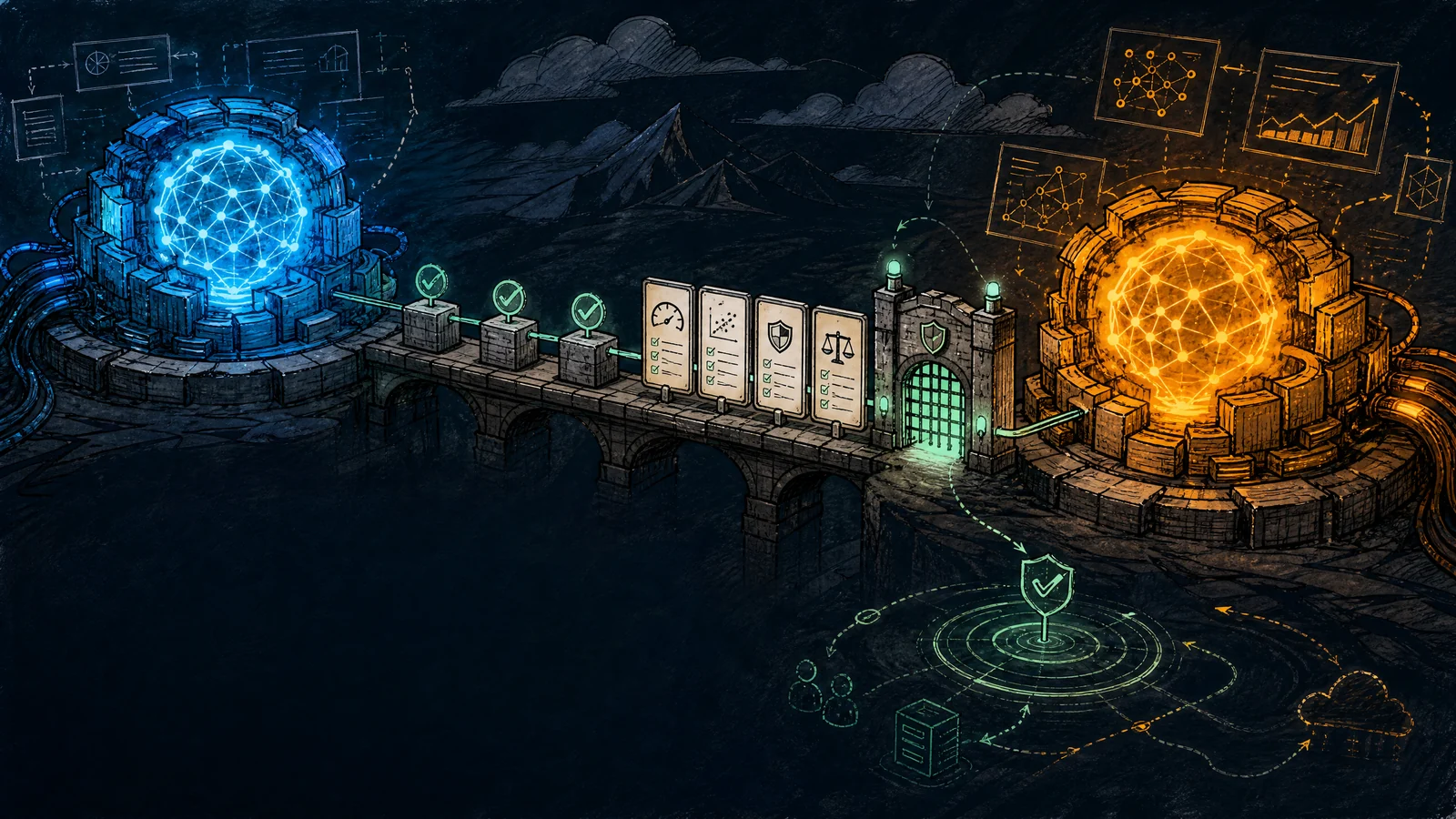
A model upgrade often arrives as a one-line configuration change. Replace model-a with model-b, run the deployment, and watch the dashboard turn green. The diff may be tiny, but the behavior behind it is not. A new model can change how an agent interprets intent, chooses tools, formats arguments, refuses requests, cites evidence, spends tokens, or recovers from a failed step.
That is why I do not treat a model upgrade as a dependency bump. I treat it as a behavioral release.
The distinction matters because a model endpoint is not a pure function with a stable output contract. Even when the prompt and application code stay unchanged, the distribution of outputs can move. Some changes are welcome: fewer unsupported claims, better structured arguments, lower latency. Other changes are subtle until a user notices that the agent now asks for confirmation too late, calls an expensive tool unnecessarily, or produces a valid-looking answer with weaker evidence.
Thesis: A production model upgrade is safe only when the system can describe the behavior it promises, compare the candidate against that promise, and reverse the change without improvising during an incident.
The missing layer between evals and deployment
The folio already has a natural vocabulary for AI reliability: golden sets, tool contracts, SLOs, traces, policy gates, and rollback-safe infrastructure. A model upgrade sits between these ideas. It is not just an evaluation problem, because a good offline score does not prove that a live workflow will preserve its action pattern. It is not just an observability problem, because a trace tells us what happened after traffic arrived. And it is not just a routing problem, because choosing a model is different from proving that a new version is compatible with an existing product.
A useful release process joins the layers together:
| Layer | Question before promotion | Evidence to keep |
|---|---|---|
| Contract | What behavior must remain true? | Versioned behavioral requirements |
| Offline evaluation | Does the candidate pass known and adversarial cases? | Case-level results and explanations |
| Shadow traffic | How does it behave on representative live inputs without side effects? | Paired traces and normalized diffs |
| Canary | Does the candidate remain healthy under a small real audience? | Outcome, safety, latency, and cost signals |
| Rollback | Can we restore the last known-good behavior quickly? | Immutable routing pointer and recovery test |
The key is that each layer answers a different question. Reusing a single pass rate for all of them creates false confidence.
The 2026 State of Agent Engineering report reflects the operational pressure behind this problem. In a survey of more than 1,300 professionals, 57% reported agents in production, while quality remained the most common barrier. The same report found that observability was much more common than offline or online evaluation, and that using multiple models was normal rather than exceptional. A team can therefore have excellent traces and several available models while still lacking a disciplined answer to the question: what exactly must not change when we replace one model with another?
Write the behavioral contract before the test cases
A behavioral contract is not a demand that a model produce identical prose. Exact string equality is usually the wrong test. The contract describes the properties the surrounding system relies on, including the places where variation is acceptable.
I usually divide the contract into five dimensions.
| Dimension | Contract example | What may vary |
|---|---|---|
| Answer | The response must cite the retrieved evidence and state uncertainty when evidence is incomplete. | Wording, paragraph order, harmless examples |
| Action | A refund request above the policy threshold must never call the write tool directly. | The explanation shown before escalation |
| Structure | Tool arguments must satisfy the JSON schema and preserve identifiers exactly. | Optional field order and whitespace |
| Safety | High-impact actions require a fresh approval and a preview of the effect. | The tone of the approval prompt |
| Operations | P95 latency and cost per successful task must stay within the product budget. | Distribution within the agreed tolerance |
This contract makes an important separation: invariants are the things that must remain true, while tolerances describe the acceptable movement around them. A model that uses a different sentence but preserves the same evidence and action boundary may be compatible. A model that produces a more elegant sentence but silently removes an approval gate is not.
The contract should live in version control beside the prompt, tool schema, and model reference. It can be represented as data rather than hidden in a test harness:
contract: support-agent-v3
owner: customer-operations
invariants:
  - id: evidence-required
    rule: every_policy_claim_has_source_id
    severity: block
  - id: approval-before-write
    rule: refund_write_requires_fresh_user_approval
    severity: block
  - id: tool-schema
    rule: arguments_validate_against_refund_v2
    severity: block
tolerances:
  answer_quality:
    minimum: 0.86
  p95_latency_ms:
    maximum: 4500
  cost_per_success_usd:
    maximum: 0.045
review:
  sample_rate: 0.02
  owner: ai-platform
The numbers above are examples, not universal thresholds. A support chatbot, a code agent, and a clinical workflow should not share the same tolerances. The important design choice is that the threshold is explicit, owned, and reviewable.
Compare behavior, not raw text
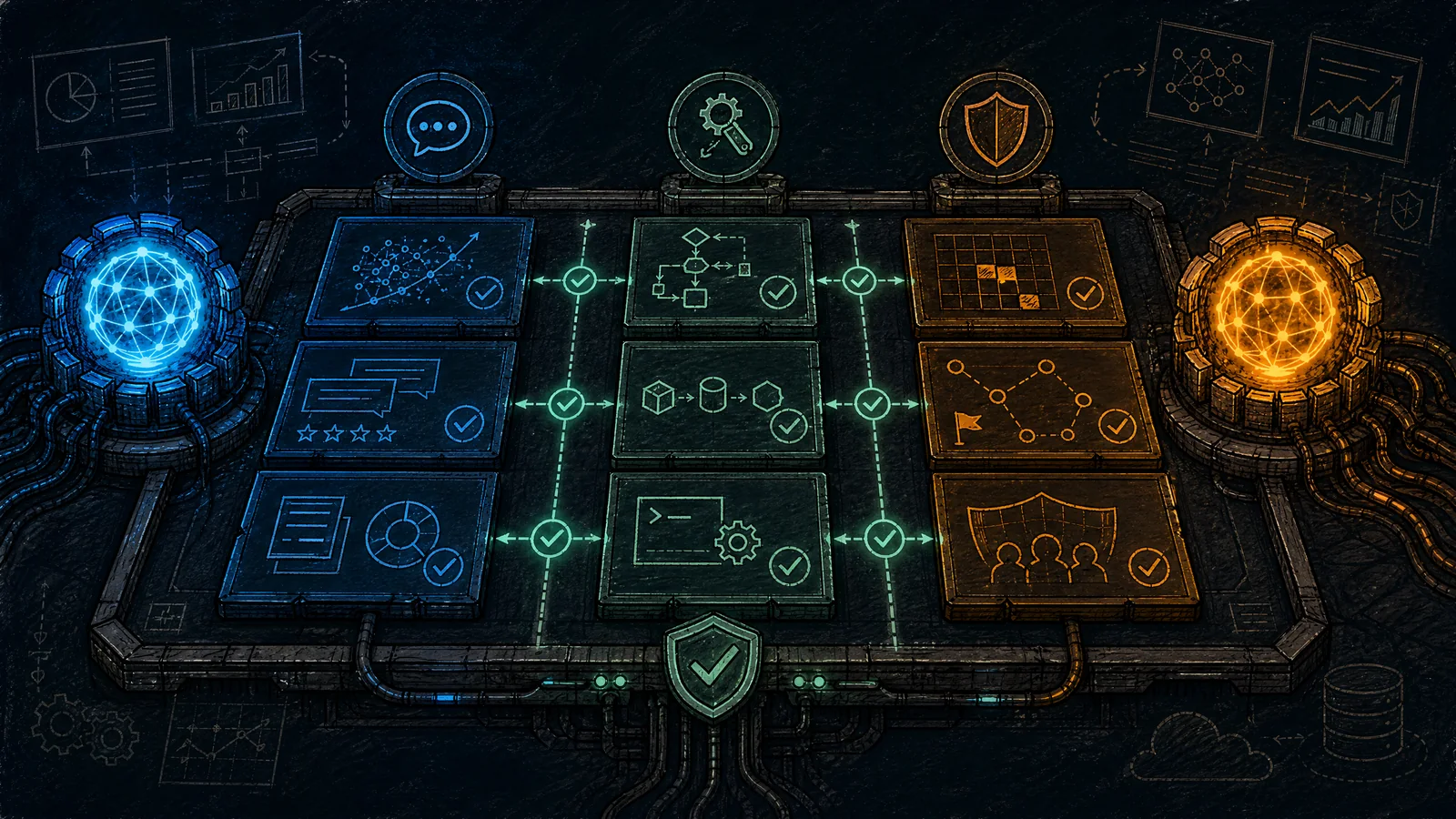
The most common first attempt at model comparison is to send the same prompt to both versions and diff the strings. That is useful for debugging, but it is a poor compatibility test. Natural language has many valid realizations, and a longer answer is not necessarily a better answer.
A better comparison pipeline normalizes each run into observable events. For an agent task, the comparison record might include:
{
  "task_id": "refund-042",
  "model": "candidate-2026-02",
  "intent": "refund_request",
  "retrieval": {
    "source_ids": ["policy-v2"],
    "evidence_coverage": 0.94
  },
  "actions": [
    {
      "tool": "refund_preview",
      "arguments_valid": true,
      "side_effect": "none"
    }
  ],
  "outcome": "needs_approval",
  "safety": {
    "approval_required": true,
    "approval_shown": true
  },
  "latency_ms": 2140,
  "estimated_cost_usd": 0.018
}
The diff then happens at several levels.
Semantic diff asks whether the answer reaches the same supported conclusion and whether important claims remain grounded. It should detect a missing caveat or a new unsupported claim, not punish a different but valid sentence.
Action diff compares tool selection, argument values, ordering, retries, and side effects. This is often more important than prose. If the baseline previews a refund and the candidate executes it, that is a blocking change even when both explanations sound reasonable.
Policy diff checks approval, refusal, escalation, and data-boundary behavior. The candidate may be more helpful in ordinary cases while being less conservative in the cases that matter most.
Operational diff compares latency, token use, cache behavior, provider errors, and cost. A candidate that passes quality but doubles p99 latency can still violate the product contract.
A practical scorecard should preserve the individual dimensions instead of collapsing them too early:
| Signal | Baseline | Candidate | Decision |
|---|---|---|---|
| Evidence-supported answers | 0.91 | 0.93 | Pass |
| Unsafe direct writes | 0.00 | 0.01 | Block |
| Valid tool arguments | 0.998 | 0.997 | Pass |
| Approval shown when required | 1.00 | 0.99 | Review/block by policy |
| P95 latency | 3.4 s | 3.8 s | Pass |
| Cost per successful task | $0.031 | $0.036 | Pass |
The scorecard makes a critical failure visible. A weighted average could hide one unsafe write behind thousands of successful conversational turns. Release decisions should use hard gates for safety and correctness, then use soft thresholds for quality and operations.
Shadow traffic: observe the candidate without giving it authority
Offline tests are necessary but narrow. They usually contain carefully selected cases, and they do not capture the messy distribution of real requests: incomplete context, unusual identifiers, repeated users, long histories, and tool failures arriving at inconvenient moments.
Shadow traffic provides a bridge. The production system sends a copy of an eligible request to the candidate, but only the baseline is allowed to produce the user-visible response or execute a side effect. The candidate runs in a sandboxed path with tools replaced by read-only simulators, recorded responses, or no-op adapters.
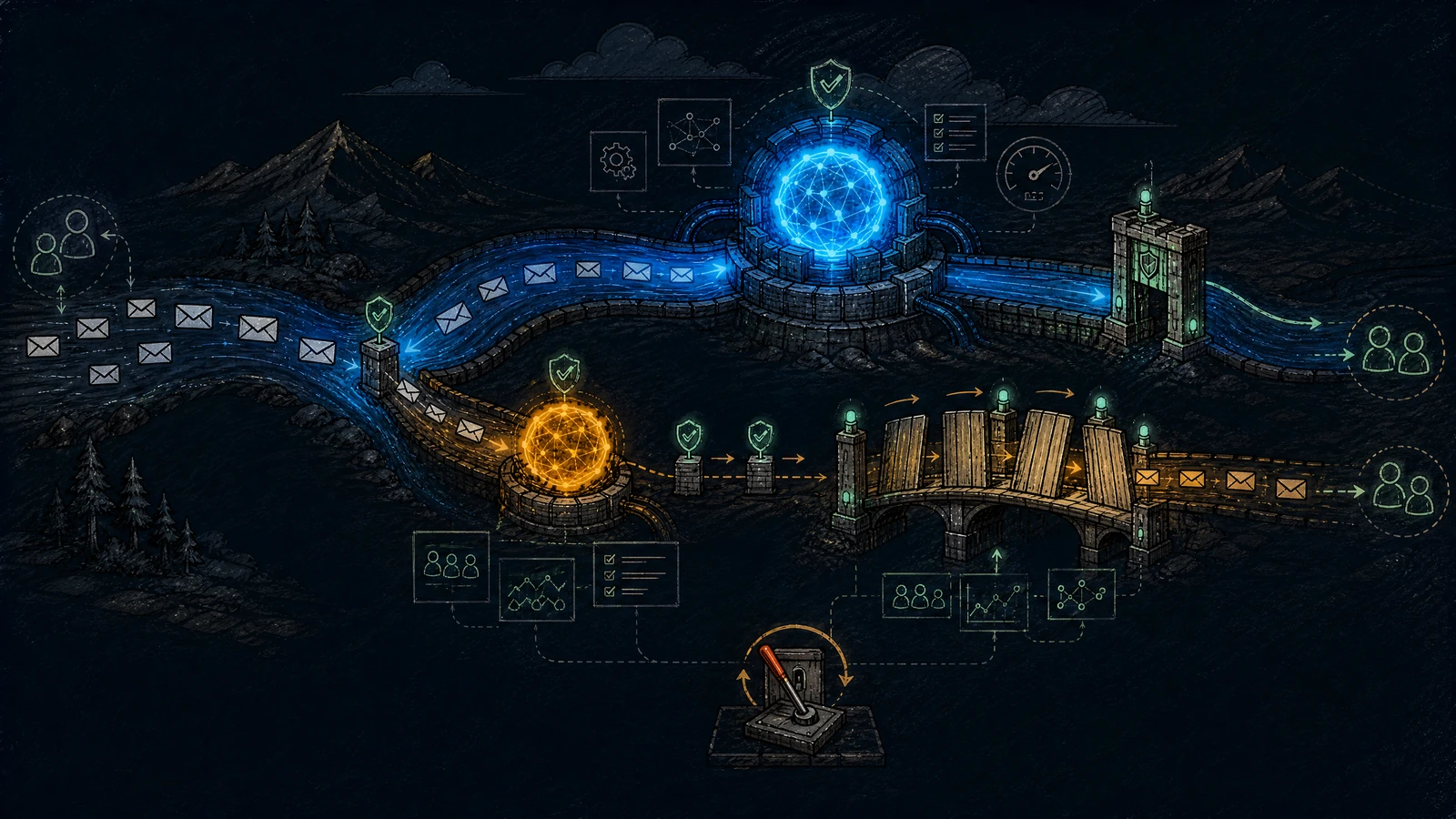
Shadowing sounds simple until privacy and determinism enter the picture. The candidate may see personal data, secrets in tool results, or content that the team is not allowed to retain. The comparison pipeline should therefore define a data policy before collecting shadow traces:
- Redact or tokenize fields that are not required for the behavior under test.
- Keep a short retention window for raw payloads and a longer window for aggregate results.
- Disable real writes, outbound messages, purchases, account changes, and other effects.
- Store the contract version, prompt version, tool definitions, model identifier, and runtime configuration with each comparison.
- Sample by workflow and risk class rather than sampling only by volume.
Sampling only random traffic can miss the most important cases. A two-percent sample of ordinary questions may produce a reassuring report while collecting zero examples of rare high-impact actions. Use a stratified policy: a small continuous sample for volume, targeted replay for high-risk workflows, and a holdout set of adversarial or previously failing cases.
Canary promotion is an evidence-accumulation problem
After offline and shadow checks pass, a canary should not be framed as a binary switch. It is a sequence of increasingly costly observations.
Start with a small cohort or a workflow that has a clear recovery path. Keep the baseline available for comparison, and define the promotion and abort rules before traffic moves. A canary controller might evaluate windows such as:
candidate receives 1% of eligible requests
observe 15 minutes or 500 completed tasks
if any blocking safety invariant fails: abort immediately
if quality delta < -0.03 or p95 latency > budget for two windows: pause
if success, safety, and cost remain within contract for three windows: promote to 10%
repeat with a larger cohort
The exact percentages and windows depend on traffic volume. A low-volume product may need time-based windows; a high-volume system may use completed-task counts. What matters is that the controller knows the difference between not enough evidence and evidence of failure.
Keep the comparison fair. Route similar workflow types to both versions, avoid changing the prompt and model at the same time, and record external dependencies that could explain a shift. If the retrieval index, tool schema, policy file, and model all change in one release, the system may detect a regression without being able to identify its cause.
Rollback is a product capability, not a pager ritual
A rollback plan that says “restore the old environment variable” is incomplete. During an incident, the old model may be unavailable, its provider may be degraded, its credentials may have expired, or the new version may already have changed a shared prompt or tool contract.
A robust rollback keeps several things immutable and independently addressable:
| Item | Why it belongs to the release pointer |
|---|---|
| Model identifier and provider | The name alone may not identify the actual behavior or endpoint. |
| System prompt and policy bundle | A model is evaluated in the context it will receive in production. |
| Tool schemas and adapters | Old behavior may depend on an older argument contract. |
| Retrieval configuration | Chunking, reranking, and filters can change the output distribution. |
| Feature flags and cohort rules | A rollback must stop candidate exposure, not merely change the model string. |
| Contract and eval version | The team must know what “known good” meant at the time. |
Test rollback before promotion. Route a small synthetic workflow through the baseline after deployment and verify that the old path still has working credentials, compatible tools, and healthy capacity. If rollback has never been rehearsed, it is a hope, not a control.
Detect drift after the release is green
A candidate can pass all pre-release checks and still degrade later. User behavior changes. Providers modify serving behavior. A new product surface sends longer context. Tool failures become more frequent. The distribution of tasks moves outside the shadow sample.
Post-release monitoring should therefore compare the candidate against a baseline of expected behavior, not only against infrastructure health. Track at least four classes of signals:
| Signal class | Examples | Typical response |
|---|---|---|
| Outcome | Task completion, escalation, correction, abandonment | Investigate workflow or prompt changes |
| Evidence | Citation coverage, retrieval disagreement, unsupported claims | Add cases or tighten evidence gates |
| Action | Tool choice, argument repair, retries, approval rate | Pause or rollback if risk rises |
| Operations | Latency, tokens, provider errors, cost | Tune budgets, capacity, or routing |
NIST’s work on evaluation probes points in the same direction: automated verifiers can be integrated directly into an agent workflow, and their results can be accumulated into a machine-readable audit trail that connects decisions to supporting evidence. The important idea is not a particular judge model. It is the feedback loop: the release system continues checking the contract after the deployment ceremony is over.
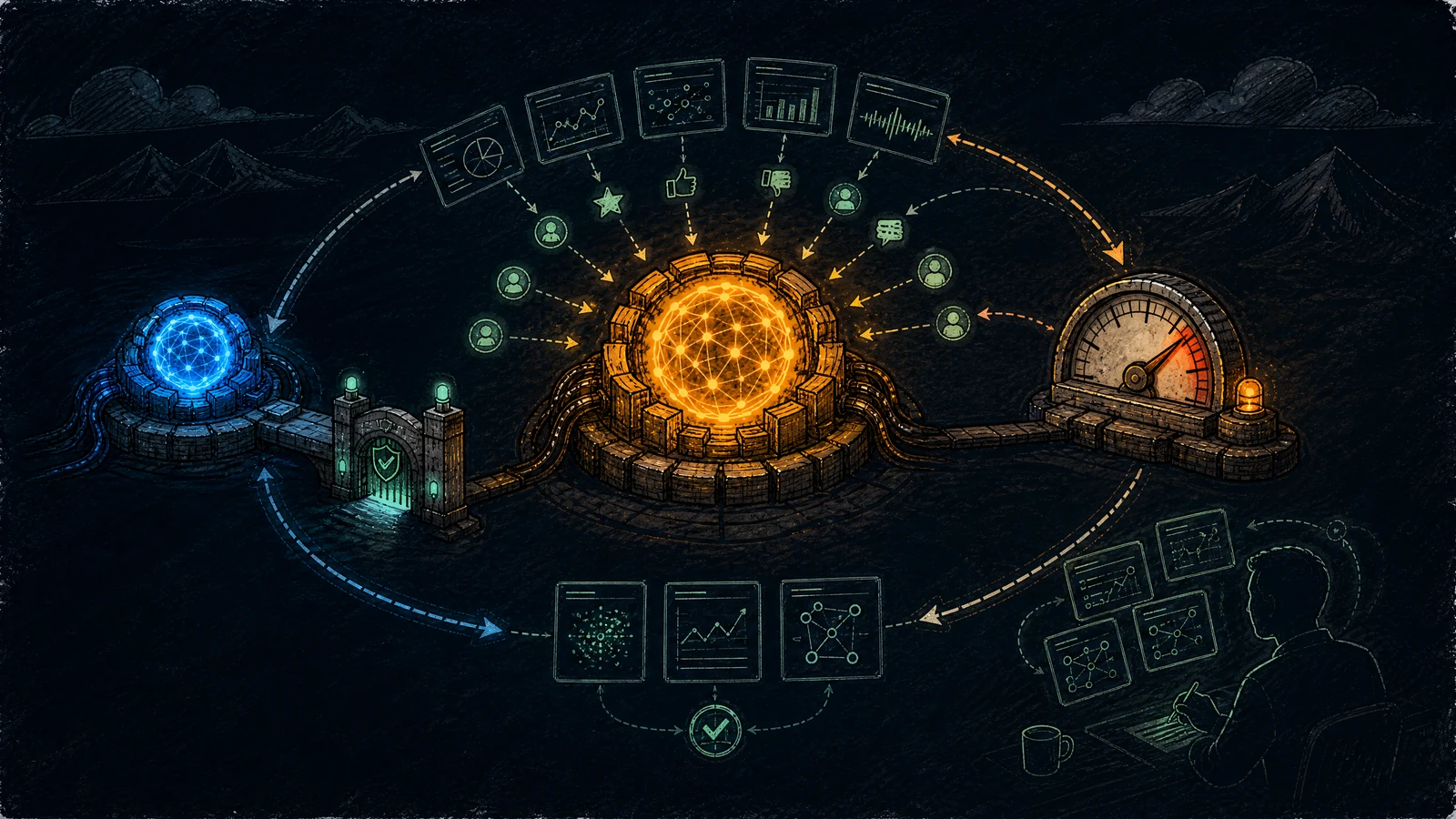
When drift appears, avoid automatically blaming the model. A change in retrieval coverage, user mix, tool availability, or policy configuration may create the same symptom. Preserve the comparison record so an incident review can ask: which observable behavior moved, when did it move, and which dependency changed at the same time?
Failure modes that look responsible in a dashboard
The average-score trap happens when a candidate improves the mean while regressing a small high-risk class. Fix it with per-workflow and per-risk gates.
The string-diff trap treats every wording change as a regression. Normalize claims, actions, evidence, and policy outcomes before comparing prose.
The shadow-with-side-effects trap gives the candidate real credentials because the test harness is convenient. Replace write tools with simulators and make unauthorized effects structurally impossible.
The moving-baseline trap compares the candidate with a baseline that is changing during the test. Pin both sides to immutable prompts, tools, retrieval settings, and provider configuration.
The canary-without-abort trap sends a small percentage of real users to the candidate but has no automatic stop condition. A canary without an abort rule is simply a slow rollout.
The rollback-only-in-config trap assumes the previous model is the only artifact that matters. In reality, the previous prompt, tool schema, retrieval policy, and capacity plan may be part of the known-good behavior.
A practical release checklist
Before approving a model upgrade, I want the team to answer these questions in writing:
- Which behaviors are invariants, and which changes are within tolerance?
- Which high-risk workflows have dedicated cases and negative paths?
- Can the candidate run without real side effects under shadow traffic?
- Are model, prompt, tools, retrieval, policy, and contract versions pinned together?
- Does the comparison distinguish semantic, action, safety, and operational differences?
- Are release thresholds separated into blocking gates and review thresholds?
- Can the controller pause or abort a canary without waiting for a human to notice?
- Has rollback been exercised against the exact release bundle?
- Which post-release signals reveal drift before a user escalation becomes the first alert?
A small team does not need an elaborate platform to start. A versioned contract file, a replayable test set, a no-side-effect shadow runner, a structured diff record, and a reversible traffic pointer are enough to create the first useful control loop. The system can grow from there.
Closing perspective
Model upgrades are inevitable. The mistake is not changing the model; the mistake is changing it without making the promised behavior explicit.
The safest teams do not ask whether the new model is “smarter” in the abstract. They ask whether it remains compatible with the work the product is trusted to do. They define the action boundaries, evidence requirements, quality tolerances, and operational budgets that matter. They compare the candidate on those dimensions, expose it gradually, and keep a tested path back to the last known-good release.
That approach turns model change from a leap of faith into a normal engineering operation. The model can improve. The system can learn. And when behavior moves in the wrong direction, the team has enough evidence to see it—and enough control to stop it.
Comments (0)