
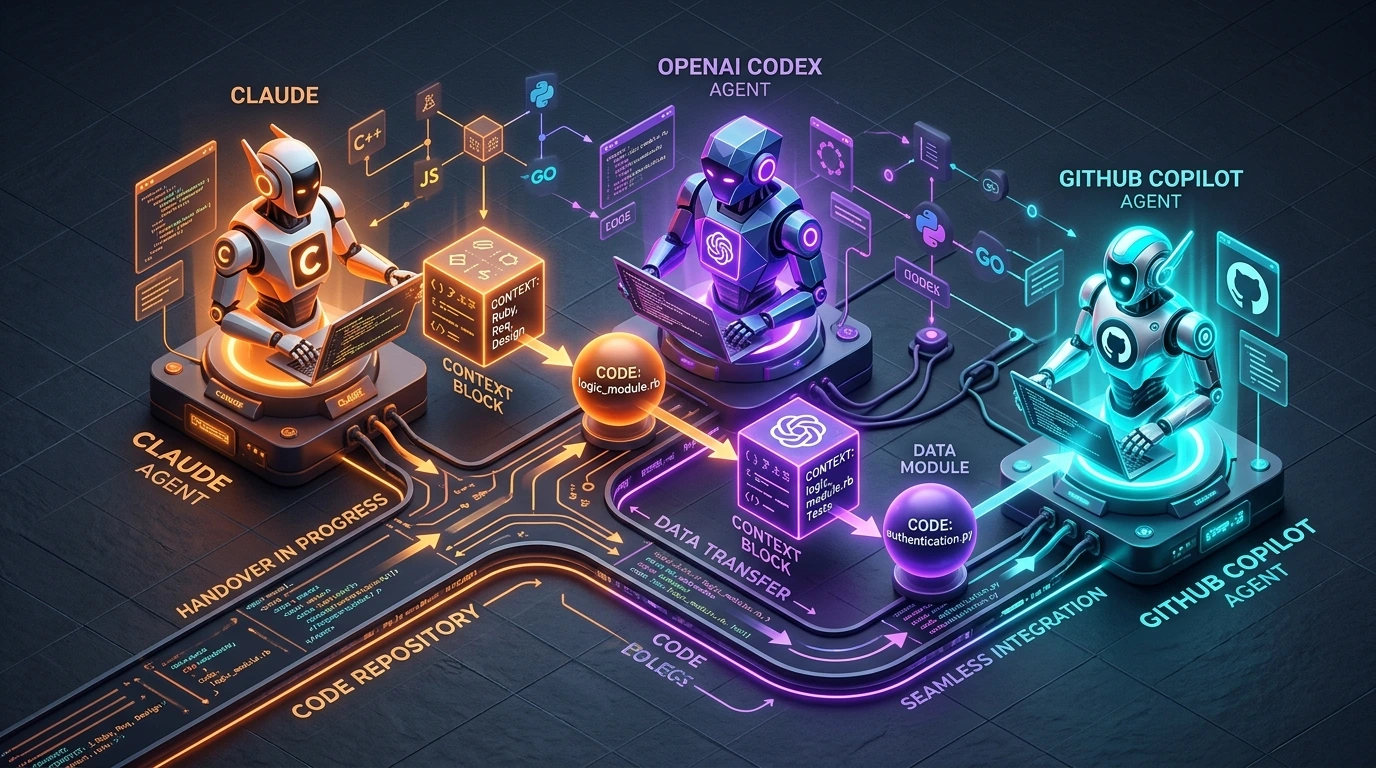
Every AI coding agent is brilliant for exactly one session and then gets amnesia. You spend forty minutes explaining why the repository is feature-sliced instead of layered, the agent does great work, the window closes — and tomorrow a different agent (or the same one, fresh) walks in and proposes a services/ folder again.
The usual reaction is to pick a “main” agent and stick with it. That’s the wrong axis. The interesting question isn’t which agent — it’s how work is handed over between them. Get that right and the agent becomes a runtime detail, swappable like a database driver.
This is a pattern I’ve been running in a multi-agent monorepo. Nothing here is tool-specific: it works with any mix of CLI agents, IDE agents, and background agents.
The core idea: the repo is the memory
Agents are stateless. The repository is not. So every piece of context that matters must live in the repo, in a place agents are contractually obliged to read and write.
Four planes, each with a distinct job:
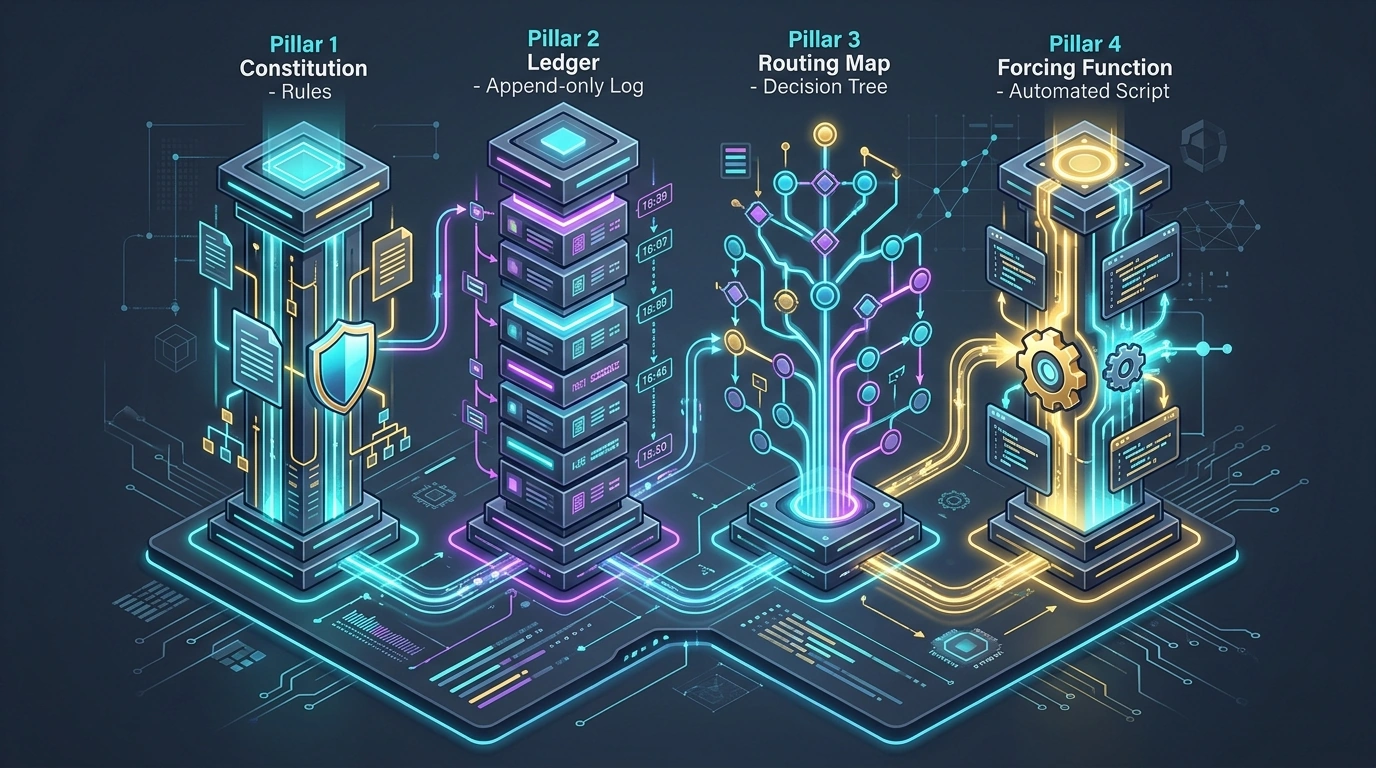
Miss any one of them and the system leaks: rules without a ledger means agents repeat decisions; a ledger without a forcing function means nobody writes to it.
Pillar 1 — One constitution, thin adapters
Every vendor invented its own instruction filename. The trap is to let each one accumulate its own dialect of the rules; three months later CLAUDE.md and the Cursor rules disagree about the test policy and each agent behaves like a different company.
Keep exactly one source of truth and make the rest pointers:
An adapter file that contains rules is a bug. An adapter file that contains a pointer is a feature.
Two things belong in the constitution and nowhere else:
- Invariants — the architectural laws (vertical slices, public contract per feature, no cross-feature internal imports, file ≤ 200 lines).
- The Definition of Done — a literal checklist the agent must satisfy before claiming completion.
Keep it short. The constitution is loaded into every session; every paragraph you add is context budget you take away from the actual task.
Pillar 2 — The Handover Ledger: Store “Intent”, Not Diffs
This is the heart of the architecture: an append-only log where every AI agent is contractually obliged to write an entry before its session ends.
The key distinction: The Handover Ledger is not a Changelog. git log already tracks what lines of code changed (Diffs). But Git is completely blind to Design Intent — the answer to: “Why was this decision made over another?”
The Fatal Difference: Git Log vs. Handover Ledger
❌ Git Commit: "refactor: use in-memory repository for user service"
👉 Next Agent thinks: "This code is sloppy! Let me rewrite it with Postgres right now!"

✅ Handover Ledger: "Using In-Memory Repo deliberately for fast UI mocking. Postgres integration deferred because DB schema is pending approval. Task #1 for next session: Connect Postgres."
👉 Next Agent reads: "Got it! Keep Mock Repo untouched, focus on finalizing Postgres schema per Task #1!"
Anatomy of a Production Handover Entry
A high-quality handover entry contains 5 core fields formatted in clean, human-readable Markdown:
### 📝 [2026-08-03 10:15] Agent: Claude-3.5-Sonnet | Task: #42-auth-jwt

- 🎯 **Scope**: `src/features/auth/`
- ✅ **Completed**: Migrated JWT verification from HS256 to RS256 asymmetric keys. Added 8 unit tests covering token expiration edge cases.
- 💡 **Decision & Rationale**: Chose RS256 over HS256 because the external API Gateway requires public key verification without sharing the private secret.
- ⏳ **Unfinished Work (Backlog for Next Agent)**:
  1. [ ] [High Priority] Implement Redis blacklist for revoked tokens upon logout.
  2. [ ] Update Auth DTO contract in `docs/api-contracts.md`.
- ⚠️ **Warning**: Must set `JWT_PUBLIC_KEY` in `.env.test` before running the test suite.
The 5 Essential Fields Breakdown
| Field | Production Value |
|---|---|
| 1. Timestamp + Agent ID | Tells the next agent if the entry is fresh and indicates which tool’s quirks generated the code (Claude, Cursor, Codex). |
| 2. Scope | Identifies touched modules (src/features/auth), allowing unrelated sessions to filter out noise instantly. |
| 3. What Was Done | High-level summary of code, config, and doc changes — the synthesis git diffs can’t provide in one paragraph. |
| 4. Decision & Rationale | The most critical field: Prevents future agents from re-litigating or blindly undoing settled trade-offs. |
| 5. Handover Backlog | The true handover: A ranked priority list written by whichever agent held the deepest context minutes ago. |
Scope Discipline: Global vs. Local Ledgers
To prevent the ledger from becoming an unreadable firehose of trivial logs:
- 🌐 Global Ledger (
HANDOVER_LOG.md): Records system-wide architectural shifts, API contract updates, and schema migrations. - 📍 Local Ledger (
src/features/auth/HANDOVER.md): Records localized refactors and internal task progress within a specific feature slice.
Pillar 3 — A routing map so agents stop guessing
Ask an agent “where do I add rate limiting?” and it will happily grep half the repo, burn context, and then invent a plausible location. A one-page decision tree answers that in ten tokens:
Work request
 ├── UI / player / component ......... → frontend feature slice
 ├── API / lessons / progress / auth .. → backend feature slice
 ├── audio, STT, LLM scoring ......... → AI service module
 └── endpoint, DTO, schema, term ..... → code + update the contract docs
Around it sit three lookups: a module map (where the equivalent class lives in each app), an API contract (endpoints and DTOs), and a glossary (domain terms and enums — the thing that keeps five agents from inventing five names for the same concept).
And the rule that keeps them alive: any change to an endpoint, DTO, schema, or term must update the corresponding doc in the same task. Docs stop being documentation and become part of the build output.
Pillar 4 — A forcing function that isn’t an AI
Here’s the uncomfortable truth: agents are unreliable graders of their own compliance. They will cheerfully tick “documentation updated” while having updated nothing. So the last gate must be a boring, deterministic script:
# 1. do the governance files still exist?
# 2. did contract-shaped files change (router/schema/dto/service)
#    without a matching change under docs/?
# 3. was the handover log touched in this session at all?
if errors:
    sys.exit(1)
That’s it — a git status parser with a regex list. It cannot be sweet-talked, it runs in CI, and it turns “please remember to update the docs” from a hope into a build failure. Every governance rule you write should be paired with the question: what dumb check proves this happened? If there’s no answer, the rule is decoration.
The session loop
Put the four planes together and every agent, regardless of vendor, runs the same cycle:
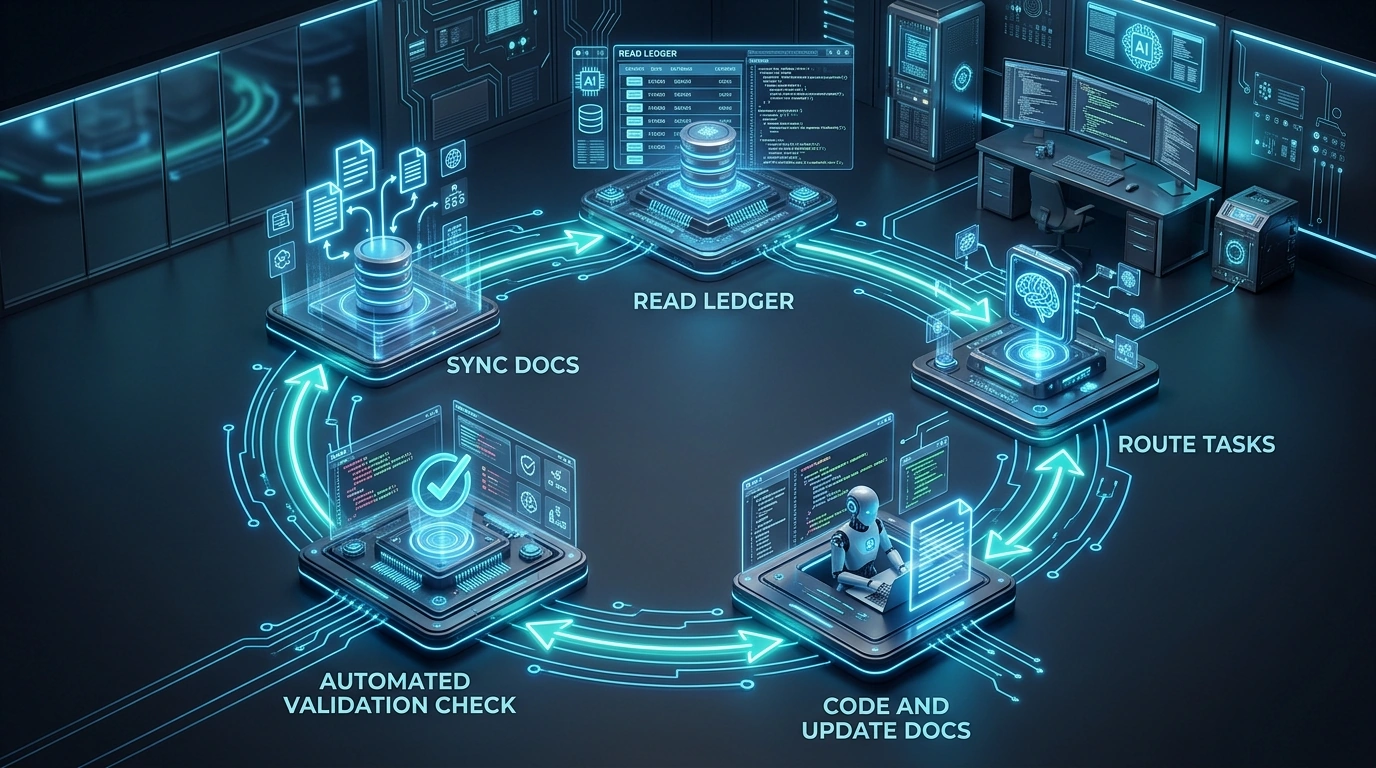
Read context → route → change code and docs together → append the ledger entry → let a non-AI script certify it. The loop closes: the output of one session is precisely the input format of the next.
Failure modes worth designing against
- Constitution bloat. It gets read every session; if it grows past a couple of pages agents start skimming it, and skimming is indistinguishable from ignoring.
- Ledger as diff dump. If entries restate the diff, nobody reads them. Entries are for decisions, rationale, and leftovers.
- Unverifiable rules. “Write clean code” cannot be checked, so it will not be followed. Prefer “file ≤ 200 lines” and “public exports only via the feature’s index”.
- Doc rot. The moment a map lies, agents stop trusting all the maps. That’s why doc updates ride in the same task as the code change, not in a follow-up.
- One giant log. Split global versus local, or the signal drowns.
Why it works
None of this is new. It’s the shift handover from hospitals and aviation: a fixed protocol, a written record of what’s pending, and a checklist that a tired human — or a stateless model — cannot skip. Multi-agent development has exactly the same shape, and it needs the same boring discipline.
The payoff is real portability. When context lives in the repo instead of a chat window, you can switch agents mid-feature, run several in parallel on different slices, or hire a human who reads the same ledger. The agent stops being your architecture. The handover protocol is.
Comments (0)